How to Compare Airline Reward Programs
Match an airline rewards program to your routes, hubs, and travel frequency. Focus on one primary program and keep a backup for uncovered routes.

Choosing the right airline reward program can save you money and enhance your travel experience. The best program for you depends on your travel habits, frequent routes, and what perks you value most. Here's a quick guide:
- Major Programs: American AAdvantage, Delta SkyMiles, United MileagePlus, Alaska Mileage Plan (Atmos Rewards), and Southwest Rapid Rewards.
- Key Factors to Compare:
- How You Earn Miles: Most programs now base earnings on ticket price, except Alaska Mileage Plan, which uses distance flown.
- Point Value: Alaska Atmos Rewards points are worth about 1.2¢ each, while others have seen declines in value.
- Airport Hubs: Dallas travelers have two options - DFW (American Airlines hub) and Love Field (Southwest Airlines).
- Redemption Options: Fixed award charts (predictable rates) vs. dynamic pricing (tied to cash fares).
- Elite Status: Benefits like priority boarding, free upgrades, and bonus miles vary by program and travel frequency.
For Dallas travelers:
- American AAdvantage: Best for DFW flyers, long-haul travel, and international routes.
- Southwest Rapid Rewards: Ideal for Love Field users, domestic trips, and flexibility.
Pro Tip: Focus on one main program (70–90% of flights) to maximize rewards, and keep a secondary program for less frequent routes. Use tools like Joe's Flights to find discounted fares while still earning miles.
| Program | Best For | Earning Miles | Point Value | Airport Hub |
|---|---|---|---|---|
| American AAdvantage | Long-haul, international travel | Ticket price-based | ~1.2¢ | DFW |
| Southwest Rapid Rewards | Domestic, flexible travel | Ticket price-based | Dynamic pricing | Love Field |
| Alaska Mileage Plan | Long-haul, discounted fares | Distance-based | ~1.2¢ | Limited in Dallas |
Focus on your travel habits, routes, and goals to pick the program that works best for you.
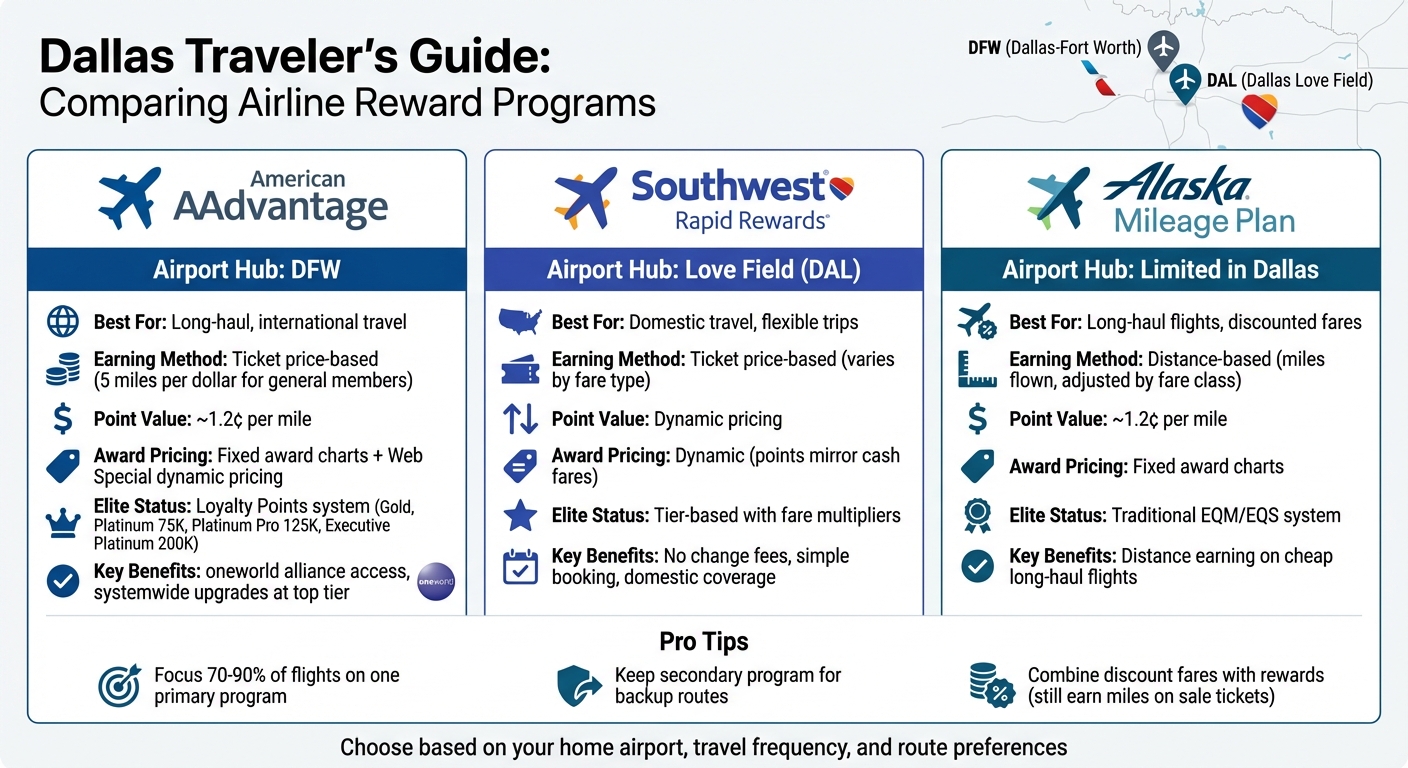
Dallas Airline Rewards Programs Comparison: AAdvantage vs Southwest Rapid Rewards vs Alaska Mileage Plan
What Are The Best Points & Miles to Have? (I Ranked Them All)
Know Your Travel Habits and Priorities
Before diving into miles, perks, and redemption options, take a step back and evaluate your travel habits. The best rewards program is one that aligns with your typical routes, travel goals, and how often you fly. Airlines design their programs to cater to specific traveler profiles, so it’s important to match your patterns with a program that genuinely complements your needs.
Find Out Which Airlines Fly From Your Airports
If you’re based in Dallas, your choice of airport - DFW or Love Field - plays a big role in determining which airlines and rewards programs make sense for you.
DFW is a key hub for American Airlines, making their AAdvantage program a natural fit if you live nearby or frequently take long-haul flights. On the other hand, Dallas Love Field is dominated by Southwest Airlines, which is ideal for travelers who favor straightforward domestic trips and flexible change policies. Southwest’s Rapid Rewards program is built around these kinds of no-hassle, shorter flights.
Start by listing your top 5–10 routes from the past year, such as DFW–LAX, DAL–DEN, or DFW–MIA, and note which airlines you flew most often. If American Airlines dominates your DFW travel, AAdvantage is likely the best match. If Southwest is your go-to out of Love Field, Rapid Rewards will fit your needs better. Tools like Joe's Flights can also help you find discounted fares from both airports, allowing you to save money while still earning miles on your preferred airline.
Decide What You Want From Rewards
Your reward goals should guide your program choice - whether you’re after free economy flights, premium international travel, or something else entirely.
For free economy flights, focus on programs that offer straightforward redemptions and serve your frequent routes. American Airlines from DFW and Southwest from Love Field are both excellent options for this. If you’re aiming for international business-class awards, look for programs with strong premium cabin options through global partners. For instance, American AAdvantage offers access to oneworld carriers like British Airways and Iberia.
Families with young kids or tight schedules might prioritize flexibility, such as no change fees, simple booking policies, and broad domestic coverage. For example, a family taking multiple DAL–Orlando trips each year may find Southwest Rapid Rewards more practical, thanks to its flexible points system and lenient change rules. Meanwhile, a business traveler flying DFW–London in premium cabins will likely get more value from American AAdvantage and its international partner network.
There’s no one-size-fits-all program - it all depends on what you want to accomplish with your miles.
Calculate How Much You Fly Each Year
Your travel frequency is another critical factor in choosing the right rewards program. It can help you decide whether to aim for elite status or focus on earning redeemable miles. Break down your annual travel into categories: light (0–3 trips or under 10,000 miles), moderate (4–12 trips or 10,000–35,000 miles), or heavy (over 12 trips or 35,000+ miles).
- Light travelers should look for programs with miles that don’t expire quickly and offer good value without requiring elite status. Southwest Rapid Rewards is a great option here, as perks like upgrades or lounge access are less relevant if you only fly occasionally.
- Heavy travelers, especially those based at DFW, may find American AAdvantage more rewarding. Frequent trips make it easier to achieve mid- to high-tier elite status, such as Platinum (75,000 Loyalty Points) or Executive Platinum (200,000 Loyalty Points). These tiers unlock valuable perks like priority boarding, free checked bags, bonus miles, and systemwide upgrades, which can significantly enhance your travel experience.
Take a look at your travel patterns from the past 12–24 months to get a clear picture of your habits. This will help you decide whether consolidating your bookings with one airline will lead to more free flights - or if it’s worth shifting some of your travel to another carrier to maximize your rewards.
Learn How Different Reward Programs Work
Understanding how various reward programs function can help you make smarter choices, especially if you're frequently flying out of Dallas. Each program has its own way of awarding miles, redeeming rewards, and granting elite status. Knowing the details can help you pick a program that aligns with your travel habits and maximizes your benefits.
How You Earn Miles or Points
Most major U.S. airlines now base mileage earnings on how much you spend rather than how far you fly. For instance, American AAdvantage awards miles and Loyalty Points depending on the base fare and carrier fees. General members earn 5 miles per dollar spent, while elite members earn even more thanks to earning multipliers. Plus, you can rack up Loyalty Points through co-branded credit cards, hotel partnerships, and dining programs, all at a 1:1 rate. These points count toward elite status, even if you're not flying.
Southwest Rapid Rewards works in a similar way. Points are awarded per dollar of base fare, but the rate varies depending on the fare type (Wanna Get Away, Anytime, or Business Select) and your elite status tier. For example, a $300 ticket will earn more points than a $100 fare, regardless of the flight distance. However, lower-priced fares, like those found through platforms such as Joe's Flights, will naturally yield fewer points.
On the other hand, programs like Alaska Mileage Plan still use a distance-based system. Here, miles are awarded based on how far you fly, often adjusted by fare class. This can be advantageous for travelers booking long-haul flights at discounted rates. For instance, a budget-friendly transatlantic ticket could earn more miles than a shorter, pricier domestic flight.
How Award Pricing Works
When it comes to redeeming miles, programs generally fall into two categories: fixed award charts and dynamic pricing. Fixed award charts set predictable redemption rates, like 25,000 miles for a domestic round trip, which can be especially valuable when cash fares are high. Dynamic pricing, on the other hand, ties the required miles to the current cash fare.
For example, American AAdvantage traditionally relied on region-based award charts for many partner and long-haul flights. However, it also offers "Web Special" awards, which use a dynamic pricing model. These Web Specials can sometimes offer better deals than the fixed charts, though prices may vary depending on demand for popular routes.
Southwest Rapid Rewards uses a predominantly dynamic pricing model, where the points required closely match the cash fare. If a flight from Dallas costs $100, the points needed will be relatively low. Conversely, a $400 ticket will require significantly more points. While this system makes it easy to understand how many points you'll need, it also reduces the chances of finding those "sweet spot" deals that fixed charts sometimes provide.
To evaluate a program's value, calculate the cost per mile. For instance, if a ticket costs $250 and requires 20,000 miles plus $11.20 in taxes, the value per mile is approximately (250 − 11.20) ÷ 20,000, or about 1.2 cents per mile. Running these calculations on routes you fly regularly - like Dallas to Los Angeles or New York - can help you determine which program offers better value for your travel patterns.
How to Earn Elite Status
Earning elite status often depends on a combination of miles flown, segments, or spending, along with a minimum number of flights. Traditional programs typically relied on elite-qualifying miles (EQMs) based on distance and fare class or elite-qualifying segments (EQSs), which rewarded frequent short trips.
American AAdvantage has taken a different approach with its Loyalty Points system. Here, you can qualify for elite status by accumulating Loyalty Points from flying, credit card spending, and partner activities. This makes it possible for frequent credit card users to achieve elite status even without extensive flying.
Elite tiers come with increasingly valuable perks. For example, AAdvantage Gold offers priority boarding, one free checked bag, and a mileage bonus. Higher tiers like Platinum (75,000 Loyalty Points) and Platinum Pro (125,000 Loyalty Points) add more free checked bags, higher mileage bonuses, and other benefits. The top tier, Executive Platinum (200,000 Loyalty Points), includes perks like a 120% mileage bonus and four systemwide upgrades per year.
Common elite benefits across programs include priority check-in and boarding, extra baggage allowances, bonus miles on paid tickets, and complimentary upgrades. These perks can save frequent travelers money and enhance their overall experience. To decide if pursuing elite status is worth it, estimate the dollar value of the benefits you'll actually use, especially on routes you fly often from Dallas.
sbb-itb-d0f92e0
Compare What You Earn and What You Can Get
To figure out which loyalty program gives you the best value from Dallas, you'll need to estimate how many miles you can earn based on your typical travel habits.
Calculate Your Potential Mileage Earnings
Start by picking a few common routes from Dallas, like DFW–LAX or DAL–DEN, and look at the economy round-trip base fares. For example, if a DFW–LAX round trip costs $400 in base fare, a program offering 5 miles per dollar would give you 2,000 miles. On the other hand, a program offering 7 miles per dollar for certain elite members would earn you 2,800 miles for the same ticket.
Keep in mind that fare class and partner airline policies can make a big difference. Discounted fares might only earn 25–50% of standard miles, while full-fare and premium tickets could earn 100–200%. Some programs, like the Alaska Mileage Plan, calculate miles based on distance flown. This means a long-haul flight at a discounted rate might earn more miles than a shorter, more expensive domestic trip. By running these numbers for both your primary airline and its partners, you can figure out which program allows you to rack up miles most effectively.
Once you’ve nailed down how many miles you can earn, the next step is to evaluate their value to complete your comparison.
How to Pick the Best Program for You
Once you've compared mileage and value options, it's time to choose the rewards program strategy that aligns with your travel habits.
Focus on Programs That Match Dallas Travel Needs
Your home airport plays a big role in deciding which rewards program works best for you. If you primarily fly out of Dallas-Fort Worth International Airport (DFW), American Airlines AAdvantage is a strong contender. American has a massive hub at DFW, offering a wide range of routes and access to the oneworld alliance. Travelers using Dallas Love Field, on the other hand, might find Southwest Rapid Rewards a better fit. Southwest offers frequent flights, a straightforward points system based on ticket prices, and no change fees [5,8].
By focusing on the program that aligns with the majority of your travel needs, you'll create a solid foundation for earning rewards. Keep a backup program in mind for those times when your primary airline or alliance doesn’t meet your travel requirements.
Combine Discount Fares With Reward Programs
Don’t overlook discounted fares - they still earn miles! Services like Joe's Flights track price drops for DFW and Love Field, such as $89 flights to New York City, giving you the chance to travel more often without breaking the bank.
When you score a low fare on your primary airline or one of its partners, you’ll still earn miles and elite-qualifying credit, even at a reduced ticket price. This allows you to stretch your travel budget further while staying loyal to your main program. For ultra-low fares on other airlines, decide whether it’s worth crediting those flights to your backup program.
Choose One Main Program and One Backup
To maximize your rewards, dedicate 70–90% of your flights to a single primary program. This helps you achieve elite status and unlock better redemption opportunities faster. Spreading miles too thinly across multiple programs can leave you with balances that are hard to use [3,4].
Pick your primary program based on the airline that serves most of your expected Dallas routes with convenient schedules and solid award availability. For instance, a business traveler might choose AAdvantage for its extensive domestic and international coverage at DFW, while using United MileagePlus or Air Canada Aeroplan as a backup for Star Alliance flights [4,5]. Families planning domestic vacations might prefer Southwest Rapid Rewards for its Love Field convenience, with AAdvantage as a backup for international trips originating from DFW [4,5].
This focused strategy ensures you’re earning rewards efficiently while getting the most practical value from your miles.
Conclusion
When comparing airline reward programs, start with a clear understanding of your travel habits. Think about which Dallas airport you frequent most - DFW or Love Field - how often you fly, and what you value most in a rewards program. Keep in mind that many programs now calculate miles based on ticket price instead of distance flown. To uncover the best value, look into how many miles you'll typically earn on your usual routes and what rewards those miles can actually get you.
For travelers in Dallas, AAdvantage is a great fit for DFW routes, while Southwest Rapid Rewards works best for those flying out of Love Field. It’s smart to focus on one primary loyalty program for the majority of your flights (70–90%) and have a secondary program for routes your main airline doesn’t cover.
To make the most of your strategy, combine loyalty rewards with affordable fares. Services like Joe's Flights can help by tracking deals from DFW and Love Field, alerting you to price drops - like $89 flights to New York City or $79 to Los Angeles. Booking these discounted tickets with your preferred airline means you’ll still earn full rewards, turning budget-friendly flights into opportunities to rack up miles.
With this approach, your everyday travel can lead to free trips down the road.
FAQs
How can I find the best airline rewards program for my travel needs?
To pick the right airline rewards program, start by thinking about your travel patterns. How often do you fly? Where do you usually go? And what perks matter most to you? These details can guide you toward a program that fits your needs. Look for one that offers plenty of miles on your usual routes, easy ways to redeem them, and extras like priority boarding, free checked bags, or access to airport lounges.
Dig into the details: check how quickly you can earn miles (the earning rate) and how much those miles are worth when redeeming them for flights or other rewards (the redemption value). Also, see if the program partners with airlines you often fly or offers deals from your local airport. By weighing these factors, you can zero in on a rewards program that complements your travel habits.
What’s the difference between fixed award charts and dynamic pricing in airline rewards programs?
Fixed award charts assign a specific number of miles to certain routes or destinations, which makes planning ahead simpler since the mileage requirements stay consistent. The downside? They might not offer much wiggle room for snagging deals.
Dynamic pricing works differently. The miles required for a reward fluctuate based on factors like demand, flight availability, and the time of year. This system can save you miles during off-peak periods, but it also makes it trickier to predict how many miles you'll need for a trip.
How can I make the most of airline rewards when flying from Dallas airports?
To get the most out of your airline rewards when flying from Dallas airports (DFW and Love Field), start by enrolling in frequent flyer programs that match your go-to airlines. These programs often offer bonus miles for flights departing from these hubs, so they’re a smart way to rack up points faster. Keep an eye out for special promotions or partnerships that could give your rewards balance an extra boost.
Another tip? Use services like Joe's Flights to score cheap flight deals. Saving on airfare means you can put more focus - and funds - into your rewards strategy. Pair this with a travel credit card that offers bonus points for airfare or other travel-related purchases, particularly for flights out of Dallas. With a bit of planning and thoughtful spending, you’ll see those rewards pile up in no time.
Related Blog Posts
Written by Joe's Flights. Spotted something cheaper? Tell us.