Cross-Border Data Rules: Impact on Flight Deals
GDPR, PIPL and new U.S. transfer rules are changing how flight-deal platforms handle consent, safeguards and real-time alerts.
Cross-border data regulations are reshaping how flight deal platforms operate. These rules - like GDPR (EU), PIPL (China), and the EU-U.S. Data Privacy Framework - dictate how personal data is transferred internationally. For platforms tracking flight prices and sending alerts, compliance means adapting to strict consent requirements, transfer safeguards, and region-specific restrictions. Key takeaways include:
- GDPR (EU): Requires data protection to "travel with the data", adding safeguards for transfers outside the EU. Non-compliance can lead to fines of up to €20 million or 4% of global revenue.
- PIPL (China): Demands explicit, individual consent for data transfers and bans unfair pricing practices. Violations may result in fines up to RMB 50 million (~$6.9 million).
- U.S. Regulations: From April 2025, bulk data transfers to certain countries (e.g., China, Russia) face restrictions, with penalties up to $1 million for violations.
Flight deal platforms like Joe's Flights must navigate these frameworks while maintaining real-time alerts. This involves balancing compliance with operational efficiency, using exemptions where applicable, and implementing robust security measures to avoid delays and penalties.
How Do You Comply With Cross-Border Data Transfer Regulations?
sbb-itb-d0f92e0
How Cross-Border Data Rules Affect Flight Deal Platforms
Flight deal platforms face a maze of challenges when it comes to obtaining consent, implementing safeguards, and avoiding prohibited data transfers. Each regulation has its own demands, directly influencing how these platforms deliver real-time alerts. Let’s break down some of the key regulatory hurdles.
Under China’s PIPL, platforms are required to get explicit, individual consent for every cross-border data transfer. David Tang from Han Kun Law Offices explains:
"A valid separate consent does not encompass a one-time consent given for multiple purposes or methods of PI processing activities".
In simpler terms, platforms can’t bundle permissions for data transfers into general user agreements. Instead, they need specific approval for each type of transfer, which can add delays to the process of sending timely alerts. On top of that, platforms using automated systems to send personalized flight deals must provide users with an easy way to opt out of targeted recommendations.
The EU’s GDPR presents another layer of complexity. It requires that data protection "travels with the data" when information is shared outside the European Economic Area. For flight deal platforms, this means adding extra safeguards, which can slow down the delivery of instant price alerts. The stakes are high: back in August 2024, the Dutch Data Protection Authority fined Uber €290 million for transferring European taxi driver data to the U.S. without valid safeguards. This violation impacted approximately 170,000 drivers.
In the U.S., cross-border data rules are also tightening. On April 8, 2025, the Department of Justice introduced a regulation restricting the transfer of bulk sensitive data to certain countries, including China and Russia. Violations of this rule can result in civil penalties as high as $368,136 or twice the transaction value, and criminal fines reaching up to $1,000,000. The rule specifically targets "data brokerage transactions", which could prevent platforms from sharing user data with international booking partners in restricted regions.
These compliance requirements come with heavy operational demands. Platforms must keep detailed records of restricted transactions for at least 10 years, conduct annual audits, and implement robust security measures like multi-factor authentication and data masking. For platforms that rely on real-time price tracking and instant alerts, these added layers of security can slow down their responsiveness, reducing the value of their services. In short, flight deal platforms must carefully balance the need for speed with the necessity of meeting global regulatory standards.
1. Joe's Flights
Data Transfer Exemptions
Joe's Flights benefits from specific exemptions that allow it to maintain uninterrupted flight alert services in the Dallas area. Under China's updated Personal Information Protection Law (PIPL), personal information transfers required for booking-related services are exempt from standard contract filings and security assessments. This means Joe's Flights can process booking-related data without facing the stricter compliance measures typically required in China.
For European users, Joe's Flights operates under the EU-U.S. Data Privacy Framework, which took effect on July 10, 2023. By self-certifying with the International Trade Administration, U.S. companies like Joe's Flights can legally receive personal data from the EU without needing additional safeguards. Similar data-sharing mechanisms cover the UK (effective October 12, 2023) and Switzerland (effective September 15, 2024). These frameworks allow Joe's Flights to operate seamlessly across multiple regions while adhering to compliance standards. However, these exemptions also introduce unique challenges the platform must address.
Compliance Requirements
Even with exemptions, Joe's Flights must navigate strict U.S. regulations. Starting April 8, 2025, U.S. laws will prohibit sharing "bulk U.S. sensitive personal data" or "government-related data" with certain countries, including China, Russia, Iran, North Korea, Cuba, and Venezuela. This includes precise geolocation data for sensitive areas. If Dallas airports are classified as sensitive zones, the platform will face restrictions on sharing geolocation data for its alert services.
The platform also conducts thorough vendor screenings to ensure that no entities predominantly owned by restricted nations are involved. Additionally, international data transfers require contracts that explicitly prevent further sharing with these nations. These regulations have a direct impact on how Joe's Flights manages its real-time alert system.
Impact on Real-Time Alerts
These compliance rules significantly influence how Joe's Flights delivers its flight deal notifications. To meet regulatory demands, the platform employs a "least privilege" access model, ensuring employees only access the data necessary for their specific roles. For Premium users, who receive unlimited hot deals as soon as they’re available, strong security measures are in place to protect sensitive data while maintaining the speed and accuracy of alerts. This careful balance ensures Joe's Flights can comply with regulations without sacrificing the quality of its services.
2. China's PIPL Exemptions
Data Transfer Exemptions
China's Personal Information Protection Law (PIPL) carves out specific exemptions for data transfers that are crucial for fulfilling a contract. A key example is the contract performance exemption outlined in Article 524 of the "Provisions on Promoting and Regulating Cross-Border Data Flows." This allows services like flight booking platforms to transfer essential booking data without meeting all compliance measures. The Cyberspace Administration of China (CAC) has explicitly identified "hotel and flight booking" as services that qualify under this exemption.
That said, platforms must prove that the data transfer is absolutely necessary for the service. For example, sharing booking confirmations typically meets this requirement. However, it's less clear whether pre-booking activities, like sending real-time deal alerts, would qualify. The CAC has stressed that these exemptions should be interpreted narrowly, which could mean that marketing-related activities might not fall under this category.
Compliance Requirements
To comply with PIPL, platforms must obtain separate, explicit consent for every cross-border data transfer. Additionally, they are required to conduct a Personal Information Protection Impact Assessment (PIA) for each transfer.
There are also thresholds that trigger stricter requirements. For instance, transferring data involving over 1,000,000 individuals - or sensitive data for more than 10,000 individuals - requires a mandatory Security Assessment. By March 2025, the CAC had reviewed 298 Security Assessment submissions and approved 325 specific data items, evaluating them based on necessity and proportionality.
These rigorous requirements inevitably influence how companies handle real-time data, especially for services like flight alerts.
Impact on Real-Time Alerts
The PIPL's compliance rules have a direct effect on the performance of real-time alert systems. Requiring separate consent for each transfer can create additional steps in the process, slowing down user sign-ups and potentially lowering conversion rates. For routine transfers below the threshold, the CAC allows companies to make a single Standard Contractual Clauses (SCC) filing annually.
However, non-compliance comes with steep penalties. Companies found in serious violation of the PIPL can face fines of up to RMB 50 million (about $6.9 million) or 5% of their previous year's turnover. This makes it critical for businesses to carefully balance efficiency with adherence to the law.
3. EU GDPR Adequacy Decisions and SCCs
Data Transfer Exemptions
An adequacy decision ensures that a non-EU country provides data protection standards comparable to those of the EU. This allows data to flow freely from the European Economic Area (EEA) to that country without requiring additional safeguards like Standard Contractual Clauses (SCCs).
"A transfer of personal data to a third country or an international organisation may take place where the Commission has decided that the third country... ensures an adequate level of protection. Such a transfer shall not require any specific authorisation." - Article 45, GDPR
For flight deal platforms operating in the United States, the EU‑US Data Privacy Framework (DPF) - introduced on July 10, 2023 - simplifies compliance. It allows personal data to move freely from the EU to U.S. companies certified under the framework, bypassing the need for additional measures. Other jurisdictions currently recognized for adequacy include the United Kingdom (renewed until December 19, 2025), Japan, South Korea, Canada (commercial purposes only), Israel, and Switzerland, with updates expected by early 2026.
Compliance Requirements
If no adequacy decision applies, platforms must rely on Standard Contractual Clauses (SCCs) - pre-approved templates designed to ensure data protection standards are upheld during international transfers. These modern SCCs are versatile, covering a range of transfer scenarios, but they come with added responsibilities. For instance, companies must conduct a Transfer Impact Assessment (TIA) to confirm that the destination country’s laws align with GDPR protections.
The Schrems II ruling reinforced the importance of documenting TIAs when using SCCs. According to the IAPP‑EY Annual Privacy Governance Report 2019, 88% of respondents cited SCCs as their primary method for handling cross-border data transfers. Additionally, as of December 27, 2022, all agreements must adopt the updated 2021 SCCs, as older versions are no longer valid. While these measures ensure compliance, they can also affect operational workflows.
Impact on Real-Time Alerts
Adequacy decisions simplify data transfers, treating exchanges with recognized countries as if they occurred within the EU. This benefits real-time flight alert systems, enabling seamless data sharing for booking confirmations and notifications.
For U.S.-based platforms like Joe's Flights, certifying under the EU‑US Data Privacy Framework is the most straightforward solution. It eliminates the need for case-by-case TIAs and supports the rapid data processing essential for real-time alerts. On the other hand, platforms relying on SCCs face additional hurdles, such as documenting TIAs, adhering to contractual obligations, and potentially implementing extra safeguards. These steps can delay the integration of new data sources, impacting the speed and efficiency of real-time notifications.
Pros and Cons
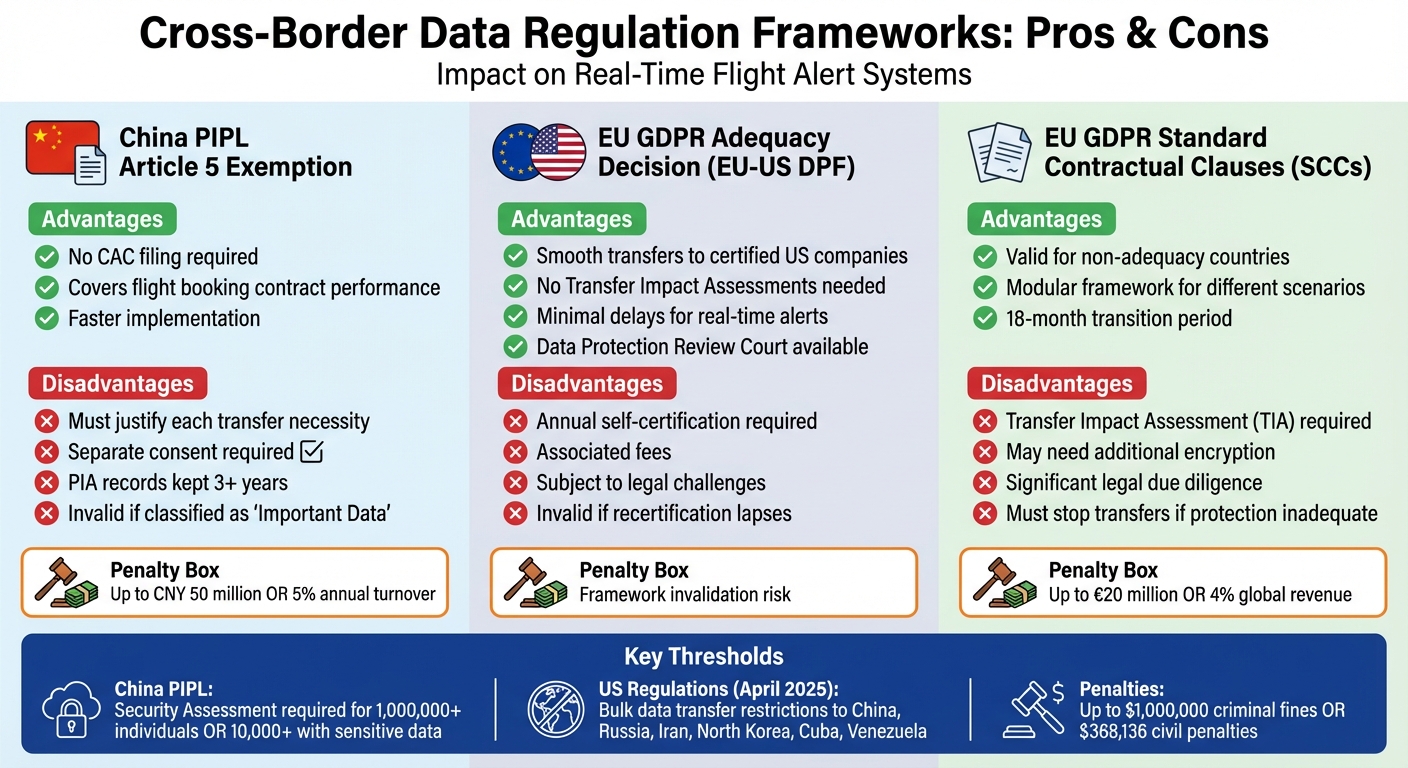
Cross-Border Data Regulation Frameworks Comparison for Flight Deal Platforms
The table below outlines the main advantages and drawbacks of different regulatory frameworks, emphasizing their impact on how flight deal platforms handle cross-border data transfers.
| Framework | Advantages | Disadvantages |
|---|---|---|
| China PIPL Article 5 Exemption | • Avoids the need for a CAC filing or formal certification, enabling quicker implementation. It explicitly covers "contract performance" for flight bookings [4, 36]. | • Platforms must justify the "necessity" of each transfer, secure separate consent (e.g., through an unticked checkbox), and maintain a Personal Information Protection Impact Assessment (PIA) for at least three years. Additionally, the exemption is invalid if the data is later classified as "Important Data" [4, 26, 37]. |
| EU GDPR Adequacy Decision (EU-US DPF) | • Allows smooth data transfers to certified U.S. companies without requiring additional Transfer Impact Assessments, supports real-time alerts with minimal delays, and offers a Data Protection Review Court for complaints [23, 38]. | • Requires annual self-certification, associated fees, and compliance with core privacy principles. It is also subject to legal challenges, and any lapse in recertification immediately invalidates the mechanism. |
| EU GDPR Standard Contractual Clauses | • Provides a valid option for data transfers to countries lacking an adequacy decision, uses a modular framework for different scenarios, and includes an 18-month transition period for updating agreements [39, 40]. | • Demands a Transfer Impact Assessment (TIA) to examine local surveillance laws, may require additional encryption or technical safeguards, and involves significant legal and technical due diligence during setup. Transfers must stop immediately if adequate protection cannot be ensured [39, 40]. |
These frameworks directly influence how flight deal platforms operate. For example, Joe's Flights, a platform competing in the fast-paced Dallas market, benefits from the EU-US Data Privacy Framework by avoiding the need for case-by-case assessments, which helps maintain the speed crucial for real-time fare alerts. Meanwhile, platforms using Standard Contractual Clauses (SCCs) face initial delays due to the required due diligence and TIAs but gain flexibility for transferring data to countries without an adequacy decision. Under China's PIPL, the Article 5 exemption can help platforms skip time-consuming CAC Security Assessments. However, if flight data is later classified as "Important Data", the exemption becomes void, requiring a formal Security Assessment [4, 26, 37].
Compliance costs vary across frameworks. China's PIPL imposes steep penalties for violations, with fines reaching up to CNY 50 million or 5% of annual turnover [26, 37]. The GDPR adequacy framework shifts risks toward potential invalidation of the framework itself rather than direct fines. Platforms using SCCs face the possibility of halting data transfers if their TIAs reveal that local laws undermine the protections offered by the clauses.
Conclusion
Navigating the complexities of cross-border data regulations is no small feat for flight deal platforms. These rules demand precise justifications for data transfers, thorough impact assessments, and strict adherence to both national and international standards. For instance, China’s PIPL requires platforms to justify every single data transfer while conducting detailed security assessments. Meanwhile, the EU’s GDPR ensures data protection accompanies the data wherever it goes, relying on mechanisms like adequacy decisions and Standard Contractual Clauses. In the U.S., bulk transfers of sensitive data to specific countries face strict limitations.
"The era of treating cross-border data transfers as routine business operations has ended, and data governance has been solidly recognized by the U.S. government as a strategic imperative." - FTI Consulting
For platforms like Joe’s Flights, which provides real-time alerts to users flying out of Dallas, compliance starts with understanding and mapping data flows. By carefully mapping out each transfer, the platform ensures alignment with the relevant regulations. This approach helps determine which legal frameworks apply and what safeguards need to be in place to stay compliant.
Practical measures include leveraging travel-related exemptions and updating contractual safeguards to meet international transfer requirements. In cases where data transfers involve over 1 million individuals in China or exceed 10,000 personal identifiers sent to restricted countries, additional security assessments become mandatory. These steps are critical for maintaining compliance without sacrificing service quality or speed.
To keep delivering fast and accurate alerts while meeting regulatory demands, platforms must automate compliance processes and prioritize privacy in their system design. By treating data governance as a strategic cornerstone, flight deal platforms can continue to serve their users effectively while avoiding risks such as fines of up to $1,000,000 or even imprisonment for deliberate violations.
FAQs
How do international data regulations affect the speed of flight deal notifications?
International data regulations can pose challenges for flight deal platforms. Rules around data localization, transfer restrictions, and added security measures often slow down the process of analyzing fares and sending real-time alerts.
Take Joe's Flights, for example. This platform is all about delivering timely flight deal notifications from Dallas airports. But meeting regulatory requirements can sometimes delay how quickly subscribers get updates. To tackle this, Joe's Flights has fine-tuned its systems to keep alerts as fast and accurate as possible, ensuring users stay informed without unnecessary delays.
How does Joe's Flights comply with China's PIPL for cross-border data transfers?
Joe's Flights operates in line with China's Personal Information Protection Law (PIPL) by leveraging certain exemptions for cross-border data transfers. These exemptions include cases where the transfer is necessary to fulfill a contract and instances involving data from fewer than 100,000 individuals.
By following these guidelines, Joe's Flights ensures it can deliver real-time flight deal alerts to its subscribers while staying compliant with global data protection laws.
What happens if flight deal platforms don’t comply with global data regulations like GDPR?
Failing to meet global data regulations like GDPR can lead to massive fines - sometimes climbing into the millions - along with the possibility of lawsuits. But the financial hit isn’t the only concern. Mishandling personal data or experiencing breaches can erode customer trust, which can seriously damage a platform's reputation and future prospects.
For flight deal platforms, this could spell trouble. Non-compliance might disrupt their ability to deliver real-time alerts or tailored services, as these depend on securely managing sensitive user data.
Related Blog Posts
Written by Joe's Flights. Spotted something cheaper? Tell us.