5 Tips for Eco-Friendly Flights from Dallas
Simple ways to reduce your flight’s carbon footprint from Dallas: book nonstop, pack light, buy offsets, pick green airlines, and use low-carbon airport transport.

Flying doesn't have to come at a high environmental cost. Here are five simple ways you can reduce the impact of your flights from Dallas:
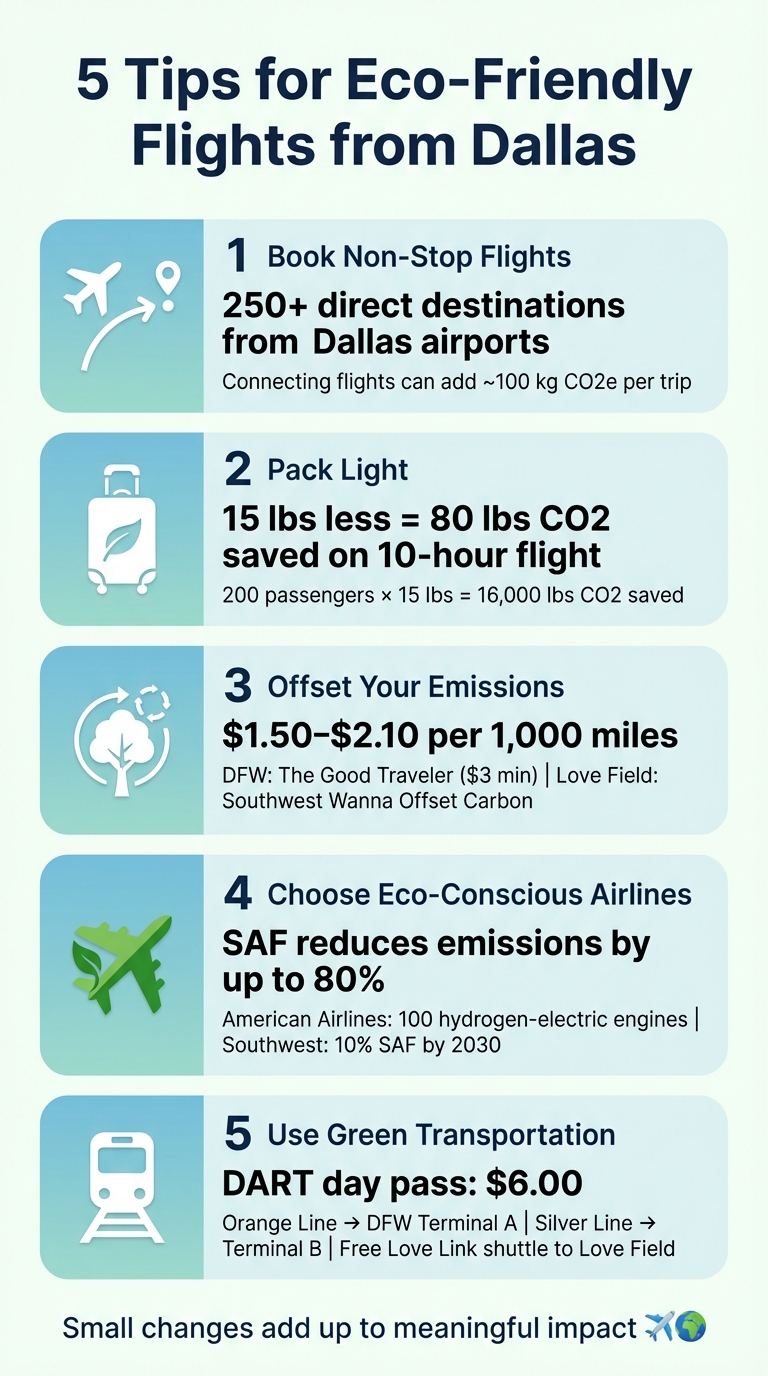
- Book non-stop flights: Fewer takeoffs and landings mean fewer emissions. Dallas airports offer direct routes to over 250 destinations.
- Pack light: Less luggage equals less fuel burned. Aim for carry-on only and skip unnecessary items.
- Offset your emissions: Programs like DFW's The Good Traveler or Southwest's Wanna Offset Carbon make it easy to balance out your flight's carbon output.
- Choose eco-conscious airlines: American Airlines and Southwest are investing in cleaner technologies like hydrogen engines and sustainable aviation fuel.
- Use green transportation to the airport: Take the DART rail to DFW or Love Field, or opt for electric vehicle charging stations if you drive.
5 Ways to Reduce Your Flight's Environmental Impact from Dallas
Ditch the Travel Guilt: 5 Tips for Sustainable Travel
1. Book Direct Flights
Opting for non-stop flights is a simple way to cut down on your carbon emissions. Why? Because takeoff and landing are the most fuel-heavy parts of any flight. Adding connections means additional cycles of these fuel-intensive maneuvers, which can significantly increase overall emissions.
"Usually, the most carbon-intensive part of a plane's journey is take-off and landing." – Skyscanner
Here’s an example: a non-stop flight from Los Angeles to the Philippines spans 7,292 miles. By choosing a connecting flight, you could add nearly 100 kg of CO2e to your trip - roughly the same amount of energy needed to power a refrigerator for an entire year.
"It's better to book one longer flight rather than multiple shorter flights so that you only have to take off and land one time." – Kaitlyn Brajcich, Sustainable Travel International
This approach is particularly effective at Dallas airports, where numerous non-stop routes help travelers avoid unnecessary emissions. DFW and Love Field airports alone offer direct flights to 250 destinations. To stay updated on direct flight options from Dallas, check out Joe's Flights () for real-time alerts. Prioritizing non-stop flights not only makes your travel more efficient but also more eco-friendly.
2. Pack Light and Use Carry-On Luggage
Every extra pound on a plane means more fuel is burned during takeoff and flight, leading to higher carbon emissions. Even small reductions in luggage weight can make a difference when multiplied across hundreds of passengers.
"The lighter the aircraft, the less fuel it burns." – Condé Nast Traveler
Here’s an example: ditching one pair of shoes could save 5.5 pounds of CO2, and trimming your bag by 15 pounds might cut up to 80 pounds of CO2 on a 10-hour flight. Multiply that by 200 passengers, and you’re looking at 16,000 pounds of CO2 saved. Finnair even estimated that if every passenger packed just 2.2 pounds less in 2024, the fuel savings could power 21 flights from Helsinki to New York.
To pack smarter, start with lightweight luggage to avoid unnecessary weight before you even begin. A capsule wardrobe works wonders for cutting down on clothing, and opting for solid toiletries helps reduce both weight and plastic waste. Wear your heaviest shoes and jacket on the plane instead of packing them. If your trip involves bulky gear, like camping equipment, consider renting what you need at your destination instead of lugging it all the way from home.
Here’s a fun fact: about 33% of travelers don’t use 25% of what they pack. Before you zip up your bag, take a second look - do you really need everything? Traveling with just a carry-on not only lightens the plane but also speeds up your airport experience and keeps your essentials within reach. It’s a small change that makes a big difference for the planet, much like booking direct flights.
3. Buy Carbon Offsets
Carbon offsetting allows you to address the emissions from your flight by funding projects that reduce or remove CO2 elsewhere. These initiatives might include reforestation, renewable energy development, or methane capture. Essentially, it’s a way to balance out the emissions you can’t avoid. For travelers in Dallas, local programs make offsetting straightforward and accessible.
At Dallas-area airports, offset programs are easy to find. For instance, Dallas Fort Worth International Airport (DFW) has been part of The Good Traveler program since 2017. With a minimum charge of $3, this program supports certified projects like the Francis Beidler improved forest management initiative in South Carolina. Over at Love Field, Southwest Airlines offers the Wanna Offset Carbon program. Not only does Southwest match your offset contributions, but they also reward participants with 10 bonus Rapid Rewards points for every dollar spent, up to 500 points per month. Their supported projects include the Kootznoowoo Forest Management initiative in Alaska and the Delta Blue Carbon mangrove restoration project in Pakistan.
To ensure your offsets make a real difference, always look for trusted certifications. Verified offsets from organizations like Gold Standard, Verra, or the Climate Action Reserve are reliable options. For example, in November 2019, The Points Guy offset 2.36 metric tons of CO2 - generated from 21,665 miles of flying - by purchasing $33 worth of Gold Standard credits at $11 per metric ton. To put that into perspective, it’s roughly equivalent to the emissions from driving a gasoline car 5,941 miles.
Offsetting costs are typically affordable, ranging between $1.50 and $2.10 per 1,000 miles. However, it’s always a good idea to focus on reducing emissions first and then offsetting what remains.
"Carbon offsetting isn't a license to pollute. It's a way to take responsibility for the emissions you can't (yet) avoid, while supporting projects that actively protect or restore the planet." - Dries Grasveld, Head of Climate Projects, Regreener
sbb-itb-d0f92e0
4. Fly with Airlines That Prioritize Sustainability
Not all airlines approach environmental responsibility the same way, but if you're flying out of Dallas, you'll notice that major carriers are stepping up their efforts to adopt cleaner aviation technologies.
American Airlines, based in Fort Worth, operates one of the youngest mainline fleets, which helps improve fuel efficiency. In July 2024, the airline made a significant move by securing 100 hydrogen-electric engines from ZeroAvia. These engines, designed for regional jets like the Bombardier CRJ700, produce zero in-flight emissions other than water vapor. Additionally, American Airlines became the first customer for Graphyte, purchasing 10,000 tons of carbon removal credits. These credits will be delivered in early 2025 through a process that locks carbon in dense underground blocks.
Meanwhile, Southwest Airlines, also headquartered in Dallas, is making strides in sustainable aviation. The airline launched a subsidiary called Southwest Airlines Renewable Ventures (SARV) and invested $30 million in LanzaJet Inc. in early 2024. This investment supports its goal of replacing 10% of its total jet fuel consumption with sustainable aviation fuel (SAF) by 2030. SAF has the potential to cut lifecycle greenhouse gas emissions by up to 80% compared to traditional fossil jet fuel.
Even DFW International Airport is part of the sustainability push. The airport collects more than 32,000 pounds of used cooking oil every month from over 200 restaurants on-site. This oil is then converted into SAF through a partnership with Neste and Mahoney Environmental. When booking your next flight, consider airlines that are making meaningful investments in cleaner and greener technologies.
"Advancing the transition of commercial aviation to a low-carbon future requires investments in promising technologies, including alternate forms of propulsion." – Robert Isom, CEO, American Airlines
5. Choose Green Transportation to the Airport
Start your eco-conscious journey before you even step into the terminal. Dallas offers several low-carbon transit options that can help you reduce your travel emissions.
If you're heading to DFW Airport, rail service is an excellent choice. The DART Orange Line provides direct access to Terminal A, connecting downtown Dallas, Irving, and Plano. For those coming from northern suburbs like Richardson, Addison, or Carrollton, the DART Silver Line - which launched in October 2025 - offers a quicker route to Terminal B by bypassing downtown. With a local day pass costing just $6.00, you get unlimited rides on DART buses, rail, and the Trinity Railway Express (TRE). Plus, the GoPass app makes digital ticketing a breeze. DART trains are designed for convenience, with platform-level boarding in the center sections, making it simple to roll your luggage on and off. These options align perfectly with a sustainable travel mindset.
Travelers heading to Dallas Love Field also have efficient ground transit options. You can take the DART Green or Orange Line to the Inwood/Love Field Station and hop on the free Love Link shuttle. This shuttle runs every 15 to 20 minutes during busy hours and gets you to the terminal in just 9 minutes.
For those who need to drive, Dallas Love Field has EV charging stations available in Garages A, B, and C.
"Almost a quarter of our fleet is fueled by natural gas or electricity. Currently, we own nine Compressed Natural Gas (CNG) vehicles and 11 hybrid vehicles, representing 24 percent of our total fleet count." – Sana Drissi, Environmental Operations Manager, Dallas Love Field
Conclusion
Flying doesn’t have to mean turning a blind eye to environmental concerns. As a traveler from Dallas, you’re in a unique position to benefit from airports that prioritize sustainability, making it easier to align your travel habits with your eco-conscious values.
By embracing small yet impactful changes - like booking direct flights, choosing eco-friendly ground transportation, or even flying economy - you’re taking steps that go beyond convenience. These actions add up, turning individual efforts into meaningful contributions toward reducing the environmental impact of air travel.
"Air travel has a long journey ahead to become sustainable, but there are actions we can all take to minimise the impact of our travel choices." - Skyscanner
Not only do these choices help protect the planet, but they can also save you money. By incorporating just a few of these strategies, you’re playing a part in shaping a greener future for aviation while still enjoying the benefits of modern travel.
FAQs
How can I make sure my carbon offsets truly help the environment?
To make sure your carbon offsets actually make a difference, stick to projects certified by independent bodies like The Gold Standard or Verified Carbon Standard. These certifications ensure that the emission reductions are real, measurable, and wouldn’t happen without your funding. Be wary of offsets that focus solely on tree planting without addressing long-term forest health or selecting the right species - these can sometimes fall short.
Take time to review the project details. Look for transparency about how your money is spent, clear reporting on emission reductions, and extra perks like promoting biodiversity or investing in clean energy. Projects aimed at preventing emissions upfront - like renewable energy initiatives or methane capture - tend to be more effective than those that focus on neutralizing emissions after the fact.
Remember, carbon offsets should come after you’ve done everything you can to reduce your flight’s carbon footprint. Fly direct, combine trips, or book with fuel-efficient airlines. Once you’ve scored a great deal through Joe’s Flights, these steps will help ensure your offsets contribute meaningfully to the planet.
How can I pack light to make my flight more eco-friendly?
Packing light is a straightforward way to make your travel more eco-friendly. The lighter the plane, the less fuel it needs to burn. To start, try creating a capsule wardrobe - choose versatile clothing pieces that you can easily mix and match. Stick to just one or two pairs of shoes and roll your clothes to maximize space. For toiletries, opt for travel-sized bottles or solid alternatives like shampoo bars. A lightweight carry-on bag that fits under the seat is a great choice - it saves you from checked luggage fees and keeps the plane’s cargo weight down.
Before you leave for the airport, use a luggage scale to weigh your bag and aim to keep it under 23 lbs (around 10 kg) for domestic flights. Plan your outfits based on the weather and activities at your destination, and wear your heaviest items - like boots or a coat - on the plane to free up space in your bag. By packing smart, you’ll not only enjoy a hassle-free trip but also contribute to lowering the environmental impact of your travels.
What are eco-conscious airlines doing to promote sustainable travel?
Airlines aiming to reduce their environmental impact are adopting a range of strategies, each tailored to their specific operations and objectives. Some focus on incorporating sustainable aviation fuel (SAF), upgrading their fleets, and boosting fuel efficiency. Others are channeling efforts into renewable energy for airport operations or exploring ways to cut emissions during flights.
For example, American Airlines emphasizes renewable energy use at major hubs like Dallas-Fort Worth and gives passengers the option to offset their flight emissions. Delta, on the other hand, concentrates on modernizing its fleet and increasing SAF usage. Meanwhile, Finnair encourages travelers to make eco-friendly choices, such as packing lighter, selecting direct routes, and participating in carbon-offset programs.
These initiatives offer passengers multiple ways to contribute to greener air travel - whether through the airlines’ sustainability measures or by making mindful decisions when booking and flying from Dallas.
Related Blog Posts
Written by Joe's Flights. Spotted something cheaper? Tell us.