Maximizing Miles with Stopovers and Open-Jaw Tickets
Use stopovers and open-jaw award rules to visit multiple cities on one ticket, lower mileage cost, and combine awards with cheap cash fares.

Want to visit multiple cities on one ticket without spending extra miles? Stopovers and open-jaw tickets let you do just that. With these strategies, you can turn a basic round-trip award into a multi-city adventure, stretching your miles further.
Here’s how it works:
- Stopovers: Take a break of over 24 hours in a connecting city (e.g., Dallas to Tokyo with a 3-day stop in Honolulu).
- Open-Jaw Tickets: Fly into one city and return from another (e.g., Dallas to Paris, then back from Rome).
For example, a United MileagePlus ticket from Dallas to Europe costs 60,000 miles. By adding a stopover or open-jaw, you could visit London, Frankfurt, and Munich for the same mileage.
Key takeaways for Dallas flyers:
- Airline rules vary: Some allow free stopovers (e.g., Alaska Mileage Plan), while others charge a small fee (e.g., Aeroplan adds 5,000 points).
- United’s Excursionist Perk: Add a free intra-region flight to your itinerary.
- Plan smart: Use tools like multi-city searches and combine award tickets with cheap cash fares for flexibility.
Stopovers and open-jaw tickets are perfect for turning your miles into unforgettable experiences without extra cost. Learn the rules, plan carefully, and make the most of your travel opportunities.
What Stopovers and Open-Jaw Tickets Are
Stopovers Explained
A stopover is essentially a layover that lasts more than 24 hours at an intermediate city on your way to your final destination. It’s a great way to explore a new city during your trip without booking separate tickets. Instead of rushing through an airport, you can step out and enjoy a mini-vacation before continuing on your journey.
For instance, imagine flying from Dallas/Fort Worth (DFW) to Tokyo with a connection in Honolulu. With a stopover, you could spend three days exploring Oahu before heading off to Japan - all under the same award ticket and for the same mileage cost.
Airlines typically define stopovers as breaks of at least 24 hours for international flights. For domestic routes, the minimum stopover time can be shorter, often around 4–12 hours. The maximum duration, however, depends on the airline. For example, Air Canada Aeroplan allows stopovers of up to 45 days. If your stay exceeds the allowed time, you’ll likely need to book separate tickets, which could increase your mileage cost significantly.
Next, let’s dive into open-jaw tickets, another flexible option for travelers.
Open-Jaw Tickets Explained
An open-jaw ticket lets you fly into one city and leave from another, with you arranging your own transportation between the two points. The "jaw" refers to the gap between the cities you visit, which you can bridge using a train, rental car, bus, or even a separate flight.
Here’s an example: you could fly from DFW to Paris, travel by train to Rome, and then fly back to DFW from Rome - all on a single award ticket. Even though you handle the travel between Paris and Rome yourself, the airline prices the ticket as one booking.
There are two types of open-jaw tickets:
- A single open-jaw has one gap, such as flying into Paris and departing from Rome.
- A double open-jaw has two gaps, like flying from DFW to Los Angeles and returning from Chicago to Dallas. In both cases, you’re responsible for arranging the travel between the gaps.
When to Use Each Option from Dallas
If you’re flying out of Dallas, choosing between a stopover and an open-jaw ticket can help you get more out of your miles.
Stopovers are ideal when you want to take an extended break in a connecting city. They’re especially useful for long-haul flights to Europe or Asia. For example, a trip from DFW to Frankfurt with a four-day stopover in Dublin lets you explore Ireland before continuing to Germany. This way, you can make the most of your journey when your route naturally includes a hub city.
On the other hand, open-jaw tickets are perfect for trips where you want to visit multiple destinations without retracing your steps. They’re particularly handy for regional travel in Europe or multi-city trips within the U.S. For instance, you could fly from DFW to London and return from Edinburgh, leaving you free to travel overland between the two cities without backtracking to London.
Since DFW is a major hub for American Airlines, you’ll have access to a wide range of international connections through its network of partners. Meanwhile, travelers flying out of Love Field, which is primarily served by Southwest Airlines, can still use open-jaw tickets for domestic, multi-city trips.
Ultimately, your choice depends on your travel plans. Use stopovers for extended stays in a single city, and go for open-jaw tickets when you want to explore multiple destinations without looping back. These options open the door to even more possibilities, which we’ll explore in the next section on specific airline programs.
How to Benefit from Connections, Stopovers & Open Jaws on Award Tickets
Airline Program Rules and Restrictions
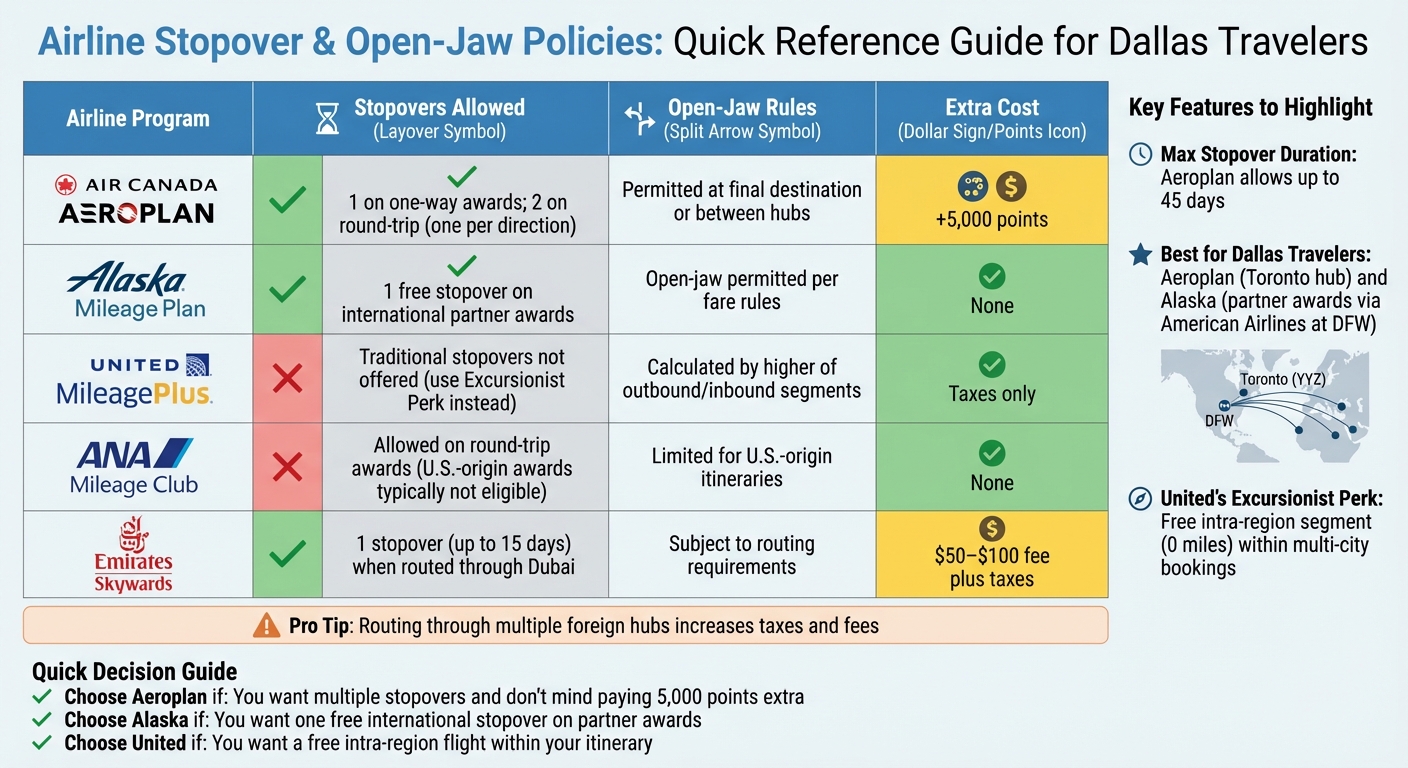
Airline Stopover and Open-Jaw Policies Comparison Chart
Stopover and Open-Jaw Policies by Airline
Understanding stopover and open-jaw rules for different airlines can help you maximize the value of your miles. For instance, Air Canada Aeroplan allows one stopover on one-way awards and two on round-trip awards (one per direction) for an additional 5,000 points. Open-jaws are also permitted, either at the final destination or between hubs. This flexibility is great for Dallas travelers connecting through Toronto on their way to Europe or Asia.
With the Alaska Mileage Plan, you can enjoy one free stopover on international partner awards, even for one-way itineraries. However, stopovers and open-jaw tickets cannot be combined on a single award. For example, you could book a DFW–Seattle–Tokyo route on Japan Airlines, include a multi-day stopover in Seattle, and still use the same number of miles - provided the itinerary includes Alaska Airlines and one partner airline.
United MileagePlus has replaced traditional stopovers with its Excursionist Perk, allowing for a no-mileage intra-region segment within a multi-city itinerary. Open-jaw routing is still possible, but miles are calculated based on the higher of the outbound or inbound segments. Similarly, ANA Mileage Club allows stopovers on round-trip awards, though U.S.-origin awards often don’t qualify due to strict partner rules. Meanwhile, Emirates Skywards permits stopovers of up to 15 days on award tickets routed through Dubai, though these typically come with a fee of $50–$100 plus taxes.
Here's a quick comparison of these rules:
| Program | Stopovers Allowed | Open-Jaw Rules | Extra Cost |
|---|---|---|---|
| Aeroplan | 1 on one-way; 2 on round-trip (one per direction) | Permitted at final destination or between hubs | +5,000 pts |
| Alaska | 1 free stopover on international partner awards | Open-jaw permitted per fare rules | None |
| United | Traditional stopovers not offered (use Excursionist Perk) | Calculated by the higher of outbound/inbound | Taxes only |
| ANA | Allowed on round-trip awards (U.S.-origin awards typically aren't eligible) | Limited for U.S.-origin itineraries | None |
| Emirates | 1 stopover (up to 15 days) when routed through Dubai | Subject to routing requirements | $50–$100 fee plus taxes |
Additional Costs: Taxes and Fees
While redeeming miles can save you money, additional segments often come with extra charges. These include airport taxes, security fees, and carrier surcharges. For example, international departures from hubs like London Heathrow can add $100 or more per segment. If you book a DFW–London–Rome–DFW itinerary with a stopover in London, you might face significantly higher cash costs compared to a simple DFW–Rome–DFW route, even if both require a similar amount of miles.
Routing through multiple foreign hubs often leads to higher out-of-pocket expenses. To minimize these costs, consider choosing hubs with lower taxes or avoiding airlines that impose high fuel surcharges. If a program doesn’t officially allow stopovers on a specific award type, you might try booking separate tickets to simulate a stopover. However, this approach can result in paying multiple sets of taxes and fees, potentially wiping out the mileage savings.
For complex itineraries, it’s worth keeping an eye on cash fares from DFW and Love Field. Tools like Joe’s Flights can alert you to fare drops in real time, making it easier to find affordable positioning flights to complete an open-jaw or connect a stopover-based route.
United's Excursionist Perk
United's Excursionist Perk offers a unique way to add a no-miles segment to your itinerary. This benefit allows for a free one-way segment within a single region, as long as it’s sandwiched between the first and last legs of a multi-city booking. The first and final segments must start and end in the same region (e.g., North America), while the free segment must be entirely within a different region (e.g., Europe). Additionally, the free segment must be flown in a cabin equal to or lower than the surrounding segments.
For instance, if you’re flying from Dallas to Europe, you could book DFW–Paris, add a Paris–Rome segment, and then return from Rome to Dallas. Using the Excursionist Perk, the intra-European flight (Paris–Rome) would cost 0 miles, so you’d only use miles for the Dallas–Europe and Europe–Dallas legs. Taxes for the intra-European flight would still apply, but the mileage savings can be substantial.
To take advantage of this perk, use United’s "Multi-city" booking tool and enter the three legs: (1) DFW–London, (2) London–Rome as your Excursionist segment, and (3) Rome–DFW. The system should display the intra-European flight at 0 miles, leaving you to pay only the applicable taxes for that leg.
sbb-itb-d0f92e0
How to Plan Multi-City Routes from Dallas
Best Stopover Cities from DFW and Love Field
Dallas-Fort Worth International Airport (DFW) serves as a major hub for American Airlines, making it an excellent starting point for Oneworld travelers. Popular stopover options include London Heathrow (LHR) via British Airways, Tokyo Narita (NRT) through Japan Airlines, and Sydney (SYD) via Qantas - all of which often feature good saver award availability. For Star Alliance members flying United, European hubs like Frankfurt (FRA), Munich (MUC), and Zurich (ZRH) are strong contenders. Meanwhile, SkyTeam travelers can connect through cities like Amsterdam (AMS) or Paris (CDG) via Delta.
These stopover cities aren’t just convenient - they’re also fantastic destinations in their own right. Imagine spending a few days in Tokyo exploring its vibrant streets and unique cuisine before heading to Southeast Asia, or using Frankfurt as a gateway for a broader European adventure. For South America, São Paulo (GRU) via LATAM offers great award availability and serves as a natural entry point to the continent.
Using Multi-City Search Tools
Once you’ve identified the best stopover hubs, you’ll need the right tools to plan your itinerary. Award search engines like United.com or Aeroplan.com are perfect for checking multi-city routes. For example, you could input a route like DFW to London (with a 3-day stopover), then London to Frankfurt, and finally Munich back to DFW to find saver-level availability on specific dates. Google Flights’ multi-city feature can also help you visually map out your itinerary, though you’ll need to confirm award space directly with the airline.
Consider trying a double open-jaw itinerary, such as flying DFW to London on the outbound leg and returning from Madrid to DFW. This can sometimes cost the same as a standard round-trip ticket, allowing you to explore multiple cities for less. Keep in mind that different programs have unique rules - Aeroplan, for instance, charges 5,000 points per stopover, while Alaska Mileage Plan includes one free stopover on international partner awards. These strategies can stretch the value of your miles, especially when combined with stopover and open-jaw benefits.
Mixing Award Flights with Paid Tickets
Sometimes, using miles for short-haul flights doesn’t deliver enough value. In these cases, it’s better to save your miles for segments where the redemption value exceeds 1.5 cents per mile. For shorter routes, paying cash might be a smarter choice. For instance, if you’ve booked DFW to London using miles but can’t find award availability for the return leg from Madrid to Dallas, a $300 ticket on a low-cost carrier could be a more efficient option.
Services like Joe’s Flights can help you find these deals. They monitor fares from DFW and Love Field, sending real-time alerts when prices drop. Past deals have included $79 flights to Los Angeles and $440 fares to Rome. In December 2025, 12 travelers even snagged $89 flights to New York City through these alerts.
Since these deals can vanish quickly, acting fast is essential - especially when piecing together complex itineraries. For example, if you’ve booked an award flight from DFW to London with a stopover but need a positioning flight from Love Field to Miami to meet family, a $99 round-trip deal spotted by Joe’s Flights could seamlessly fill the gap without draining your miles.
Program-Specific Strategies for Dallas Travelers
Air Canada Aeroplan Stopover Options
Air Canada Aeroplan offers a great way to add an extra destination to your journey without breaking the mileage bank. For a small mileage surcharge and taxes, you can include a stopover on a one-way award ticket. For instance, a direct economy award from Dallas-Fort Worth (DFW) to Toronto (YYZ) might cost 12,500 points. But if you route through Vancouver (YVR) and add a stopover, the total could rise to around 25,000 points, with approximately $100 in taxes. This approach can be much cheaper than booking separate tickets. One traveler, for example, added a three-night stopover via Aeroplan, paying only slightly more in mileage and taxes compared to booking separate flights.
Similarly, Alaska Airlines' Mileage Plan offers stopover perks that are just as appealing for travelers departing from Dallas.
Alaska Mileage Plan Partner Stopovers
The Alaska Mileage Plan allows one free stopover on one-way partner awards, giving you up to 45 days to explore the stopover city. This benefit applies to flights booked through partner airlines like American Airlines, Cathay Pacific, or Japan Airlines (but not on flights operated by Alaska Airlines). For example, a Dallas traveler could book a route from DFW to Sydney with a stopover in Honolulu on Qantas. Thanks to American Airlines' hub at DFW, these partner routings are easier to arrange.
Combining Stopovers and Open-Jaws
Some programs take flexibility even further by allowing you to combine stopovers with open-jaw segments. For example, ANA Mileage Club permits one stopover per direction on round-trip awards, along with an open-jaw leg within the same region. The rules specify that stopovers must last more than 24 hours but less than 12 months, and the open-jaw segment must be shorter than your longest flown leg. A traveler using ANA could book a round-trip itinerary from DFW with a stopover in Tokyo and an open-jaw return segment, effectively covering four cities for 120,000 miles plus taxes.
Here’s a quick look at how these combined itineraries could play out for Dallas travelers:
| Program | Sample Route from DFW | Mileage (Round-Trip) | Cities Visited | Taxes (USD) |
|---|---|---|---|---|
| Aeroplan | DFW-YVR (stopover)-NRT / KIX-HND | 95,000 | 4 | $300 |
| ANA | DFW-TYO (stopover)-KIX / OSA-ICN | 120,000 | 4 | $280 |
These strategies provide Dallas-based travelers with the tools to stretch their miles further and turn every trip into a multi-destination adventure.
Conclusion
Stopovers and open-jaw tickets can bring extra value to your Dallas award bookings while keeping your miles intact. From DFW and Love Field, you can route through major hubs like Toronto, Vancouver, London, Tokyo, or Seoul, adding exciting stops to your journey. However, taking full advantage of these options means understanding the specific rules of each airline program.
Familiarize yourself with the stopover and open-jaw policies of the programs you use. Leverage multi-city search tools on airline websites to test your routes and ensure the mileage cost aligns with what’s promised.
Don’t overlook cash fees when planning your multi-city trips. Balancing mileage redemptions with cash expenses is key to getting the most value out of your travel plans.
For even greater flexibility, combine award redemptions with smart cash bookings. Services like Joe's Flights track fares exclusively from DFW and Love Field, sending real-time alerts when prices drop. Think deals like Dallas to Europe for under $500 or Dallas to Hawaii for under $300. You can book a cheap cash fare for one part of your trip and use miles with a stopover for another, stretching both your budget and points. Since these deals disappear quickly, subscribing to alerts helps you act fast. Use the U.S. 24-hour refund rule to lock in prices while finalizing your plans.
FAQs
How can stopovers and open-jaw tickets help me get more value from my airline miles?
Stopovers and open-jaw tickets can stretch your airline miles further and make your travel experience even more exciting. A stopover allows you to spend extra time in a connecting city, essentially giving you the chance to visit two destinations for the price of one ticket. On the other hand, an open-jaw ticket lets you fly into one city and depart from another, making it a great option for exploring multiple places without the hassle of booking separate flights.
These options not only help you get more value out of your miles but also offer added flexibility for your travel plans. They’re a smart way to turn a single trip into a multi-destination adventure without breaking the bank.
What’s the difference between a stopover and an open-jaw ticket?
A stopover is when you have an extended layover in a connecting city, giving you the chance to explore that location for a few days before heading to your final destination. It’s like getting two trips in one without needing to book extra flights.
An open-jaw ticket allows you to fly into one city and leave from another, making it easier to visit multiple destinations without having to return to your starting point. For instance, you could fly from Dallas to Paris, travel to Rome on your own, and then fly back to Dallas from Rome.
How can I use United’s Excursionist Perk to save miles on multi-city trips?
United’s Excursionist Perk is a fantastic way to add a free one-way flight to your round-trip award ticket. Here’s how it works: your trip must begin and end in different regions, and the free flight segment has to stay within one region - like Europe or North America. This makes it ideal for stopovers or exploring additional cities without spending extra miles.
To get the most out of it, map out your itinerary thoughtfully and take advantage of this opportunity to see more places for the same amount of miles!
Related Blog Posts
Written by Joe's Flights. Spotted something cheaper? Tell us.